How to Fish an Evening Spinner Fall for Trout
By My Custom FlyBox Team
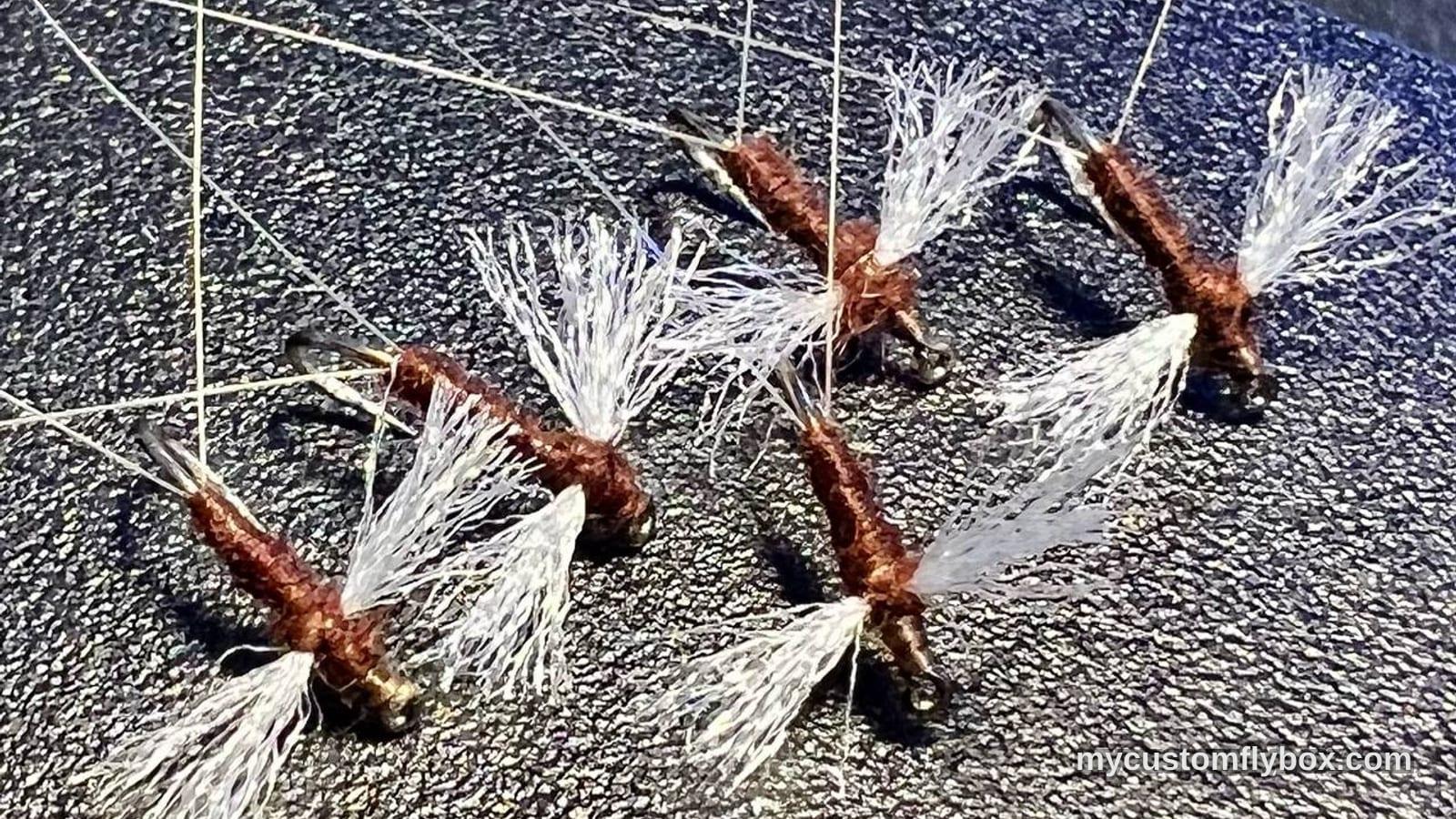
How to Fish an Evening Spinner Fall for Trout
An evening spinner fall is one of the quietest good things in trout fishing. The river may look nearly done for the day. The caddis have thinned out. The loud splashy rises are gone. Anglers are walking back to the truck, tired from watching water that seemed slow for an hour. Then, just as the light softens against the bank, a few trout start making small rings in a tailout.
That is when the river can become honest and difficult at the same time.
A spinner fall is not the same as a hatch. During a hatch, mayfly duns ride upright on the water while trout may eat nymphs, emergers, cripples, or duns. During a spinner fall, adult mayflies return to the river to mate and drop eggs. Many end up spent on the surface with wings flat in the film. They do not ride high. They do not move much. They look like almost nothing unless you get low and study the slick.
For anglers on Catskills freestones like the Beaverkill and Willowemoc, or on a technical tailwater like the West Branch Delaware, spinner falls can be the difference between a blank evening and the best dry-fly fishing of the day. They reward patience, small adjustments, and a fly box arranged by what the bugs are doing rather than by what looks pretty in the foam.
If you are choosing water for tonight, check current conditions before you leave. The West Branch Delaware fishing report gives useful tailwater context when sulphurs, olives, and technical risers are in play. The Beaverkill and Willowemoc report is the better starting point when you are judging freestone temperature, flow, and whether the evening window is safe for trout.
What a Spinner Fall Actually Is
Mayflies have a life stage that matters a great deal to dry-fly anglers. After a nymph becomes a dun, the insect leaves the water, rests on streamside brush or nearby objects, and molts again into a sexually mature adult called a spinner. The spinner usually has clearer wings, a slimmer body, and a different look from the dun stage. After mating, females return to the water to drop eggs. Dead or dying spinners then fall spent on the surface.
Some spinner falls are obvious. You see mayflies dancing over a riffle in the low light, rising and dropping together like smoke. You find spent insects in foam lines. Trout feed in rhythm, especially in slicks, tailouts, soft seams, eddies, and the cushion below faster water.
Other spinner falls are barely visible. The bugs may be small, the light may be poor, and the fish may rise so softly that each take looks like a raindrop. This is especially true with small olives, Tricos, and sulphurs on flat water. A trout taking a spent spinner often does not need to break the surface with its whole head. It can hold just under the film and sip.
The practical point is simple: slow down before changing flies. Look across the surface, not down into it. Watch the foam. Watch the inside edge of current tongues. If insects are riding flat and trout are making quiet rings, a high-floating parachute may be the wrong fly even if the size and color are close.
Timing the Last Hour of Light
Evening spinner fishing starts before the first steady rise. The best anglers arrive early enough to learn the pool while they can still see.
On many trout rivers, spinner activity builds toward dusk. Warm, calm evenings often help, but hot water can make trout care more about survival than feeding. Cool air, stable flows, and light wind are friendlier. On tailwaters, cold releases may keep trout comfortable into summer evenings. On freestones, especially during July and August, the same hour can be excellent or irresponsible depending on water temperature.
This is why the thermometer belongs in the same pocket as your dry-fly box. My Custom FlyBox already has a full guide on water temperature and trout, but the short version is simple: if trout water is near the upper stress range, stop fishing for trout. A spinner fall is not a reason to lean on fish that are already struggling.
If the temperature is safe, use the first part of the evening to watch. Stand back from the water. Note wind direction, glare, and where you can cast without lining fish. Watch whether trout are rising in one feeding lane or roaming. A fish that returns to the same seam every ten or fifteen seconds is more catchable than one that rises once near the bank and then disappears.
Where Spinners Collect
Spent spinners are light, low, and at the mercy of current. They collect where other surface debris collects. Foam lines are worth studying because they show you where dead bugs are likely to drift. A river can look empty until you kneel, look across the slick, and see tiny bodies riding with the bubbles.
Start with tailouts. The soft lower end of a pool lets trout feed near the surface without fighting much current. The mistake is wading into the tailout before you look. In evening light, good fish may slide into water that was too shallow or exposed at noon. Stay downstream and to the side if possible. Make the first cast count.
Next look at the inside seams below riffles. A riffle pushes oxygen, broken current, and food into defined lanes. Spinners drifting out of the chop often settle into the softer edge, where trout can hold a few inches under the surface and eat steadily. This water is friendlier than glassy flats because small drag mistakes are less obvious.
Back eddies and slow bank swirls can be excellent, but they are not easy. A spent spinner may circle several times before leaving the eddy. Trout in that water can face odd directions, and your fly may need a reach cast, pile cast, or downstream presentation to arrive naturally. Watch a leaf or bubble before casting. It will show you what your fly is about to do.
On the West Branch Delaware, spinner water often means long flats, seams below riffles, and soft edges where pressured fish get a careful look. On the Beaverkill and Willowemoc, think about pool tails, glassy lanes below broken heads, and shaded banks where insects from the day have collected. The exact spot changes with flow, so do not fish last year's memory without reading tonight's water.
Reading the Rise Form
Rise forms tell you more than the fly bin does.
A splashy rise in broken water may mean trout are chasing emergers, caddis, or duns still struggling through the surface. A quiet dimple or nose in a flat often points toward spinners, small emergers, or insects trapped low in the film. A bulge without a mouth can mean trout are taking just under the surface. If you see fins and backs but not noses, do not assume every fish is eating a dry.
With true spinner feeders, rhythm matters. Some trout set up in one narrow lane and eat every few seconds. Others feed in a slower pattern: rise, drift back, slide forward, rise again. If you cast at the rise ring itself, you are usually late. Cast to where the fish should intercept the next natural.
Accuracy matters, but not in the heroic way people talk about it. You do not need to throw seventy feet in the dark. You need to get within a trout's lane without dragging the fly across its window. A shorter cast from a better angle beats a long cast with three currents pulling the leader sideways.
If a fish refuses twice, do not immediately change to a completely different insect. First check drift. Then check footprint. Is the fly too high. Is the tippet making a wake. Are you landing the leader over the fish. The match-the-hatch guide is built around that sort of narrowing: change one thing at a time.
Flies for an Evening Spinner Box
A spinner box does not need to be large. It needs to be honest.
For most Eastern trout water, carry rusty spinners in sizes 12 through 20. The rusty spinner is a broad tool because many mayflies shift toward rusty or brownish tones in the spinner stage. It is not exact for every species, but it covers enough evenings to earn a permanent row.
Add sulphur spinners in sizes 14 through 18, with a few 20s for tailwater fish. On the West Branch Delaware, small sulphur spinner patterns can matter well into summer. Keep them sparse: slim yellow to orange bodies, clear or pale spent wings, and not too much hackle. For a fuller sulphur plan, see the sulphur hatch guide.
For larger mayflies, carry Hendrickson, March Brown, Light Cahill, and Isonychia spinner-style patterns in the sizes that match your water. Hendricksons are often 12 to 14. March Browns can be 10 to 12. Light Cahills commonly sit around 12 to 16. Isonychia patterns often belong in 10 to 14. These are not rigid rules, but they are useful starting ranges when you are packing for Catskills water.
Small olives and Tricos deserve their own corner. Olive spinners in 18 through 22 and Trico spinners in 20 through 24 are hard to see, hard to tie on, and sometimes exactly what a flat-water trout wants. A few drowned spinners or soft hackles can also save the evening when surface rises stop but fish are still working just below the film.
If you use the My Custom FlyBox app to organize boxes, this is a good place to build by situation instead of by pattern name: "evening spinners," "West Branch sulphurs," "Catskills rusty spinners," and "small olives and Tricos." The point is not to own every fly. The point is to find the right row while daylight is leaving. The river-specific fly box guide covers that habit in more detail.
Leader, Tippet, and Presentation
Spinner fishing punishes heavy-handed presentations. That does not always mean the lightest possible tippet. It means the leader has to land with slack, the fly has to arrive before the drag, and the fish has to see the insect before it sees your mistakes.
On broken freestone water, 5X may be fine with size 14 or 16 spinners. It turns over better, protects fish by shortening the fight, and gives you control near current. On flat tailwater water with size 18 to 22 flies, 6X may be necessary. Use the strongest tippet you can get away with and keep fights short.
Downstream and downstream-across presentations often shine during spinner falls because the fish sees the fly before the leader. They are also unforgiving. Feed slack carefully. Keep the rod low enough to avoid pulling the fly, but high enough to manage line off conflicting currents. A reach cast is often the difference between a natural drift and a fly that skates sideways.
Do not false cast over feeding fish. Dry the fly off to the side. Change position if you cannot cast without crossing the lane. Sometimes the right move is to back out, walk below the fish, and take ten minutes to set up a better angle.
A Simple Evening Plan
Start with safety and conditions. Check the gauge, the forecast, and the water temperature. If flows are rising hard, if lightning is nearby, or if water is too warm for responsible trout fishing, change plans. The river will give you another evening.
If conditions are right, arrive before the window. Watch for duns from the afternoon hatch, birds working over the riffles, and mayflies gathering above the water. Look at spiderwebs and streamside brush for insects. When you see spinners, match size first, then profile, then color.
Choose one fish if possible. Spinner falls tempt anglers to cast at every ring. That usually leads to sloppy line on the water. Pick the trout with the steadiest rhythm and the best approach angle. Feed that fish until you know whether your fly and drift are close.
If nothing happens after good presentations, change in small steps. Go lower in the film. Go one size smaller. Change from sulphur to rusty. Change from a visible parachute to a spent-wing pattern. If the fish are bulging, try a soft hackle or drowned spinner just under the film. If the rise forms get splashy again, you may be back to emergers or caddis rather than spent mayflies.
What to Pack
For a compact evening spinner kit, start with this:
- Rusty Spinners, 12-20
- Sulphur Spinners, 14-20
- Hendrickson Spinners, 12-14
- Light Cahill Spinners, 12-16
- Isonychia Spinners, 10-14
- BWO Spinners, 18-22
- Trico Spinners, 20-24
- Low comparaduns or sparkle duns in matching sizes
- Olive, tan, and brown soft hackles, 14-20
- 5X and 6X tippet
- Stream thermometer
- Headlamp with a dim or red setting
- Small drying patch and desiccant
That list will not cover every river in the country, but it covers the core jobs: big Eastern mayflies, small technical spinners, low-riding backups, and just-under-the-film options when trout stop showing cleanly.
The final piece is restraint. Spinner falls can make an angler greedy because the good window is short. Fish carefully. Land trout quickly. Stop when the water, light, or footing says the day is done. The best evening dry-fly anglers are not the ones who stay longest. They are the ones who know what they are looking at, make fewer casts, and leave the river in good shape for tomorrow.
References
- National Park Service, "Fly fishing," for general fly-fishing terminology and public recreation context: https://www.nps.gov/articles/fly-fishing.htm
- Fly Fisherman, "Pattern Feeding: Fishing Spinner Falls Successfully Means Understanding Trout Feeding Rhythms," for mayfly spinner-stage and rise-form discussion: https://www.flyfisherman.com/editorial/pattern-feeding-fishing-spinner-falls/536528
- U.S. Geological Survey publication record, "Thermal onset of cellular and endocrine stress responses correspond to ecological limits in brook trout," for sourced background on brook trout thermal stress thresholds: https://www.usgs.gov/publications/thermal-onset-cellular-and-endocrine-stress-responses-correspond-ecological-limits