Beaverkill and Willowemoc Fly Fishing: Seasons, Hatches, and Flies
By My Custom FlyBox Team
Beaverkill and Willowemoc Fly Fishing: Seasons, Hatches, and Flies
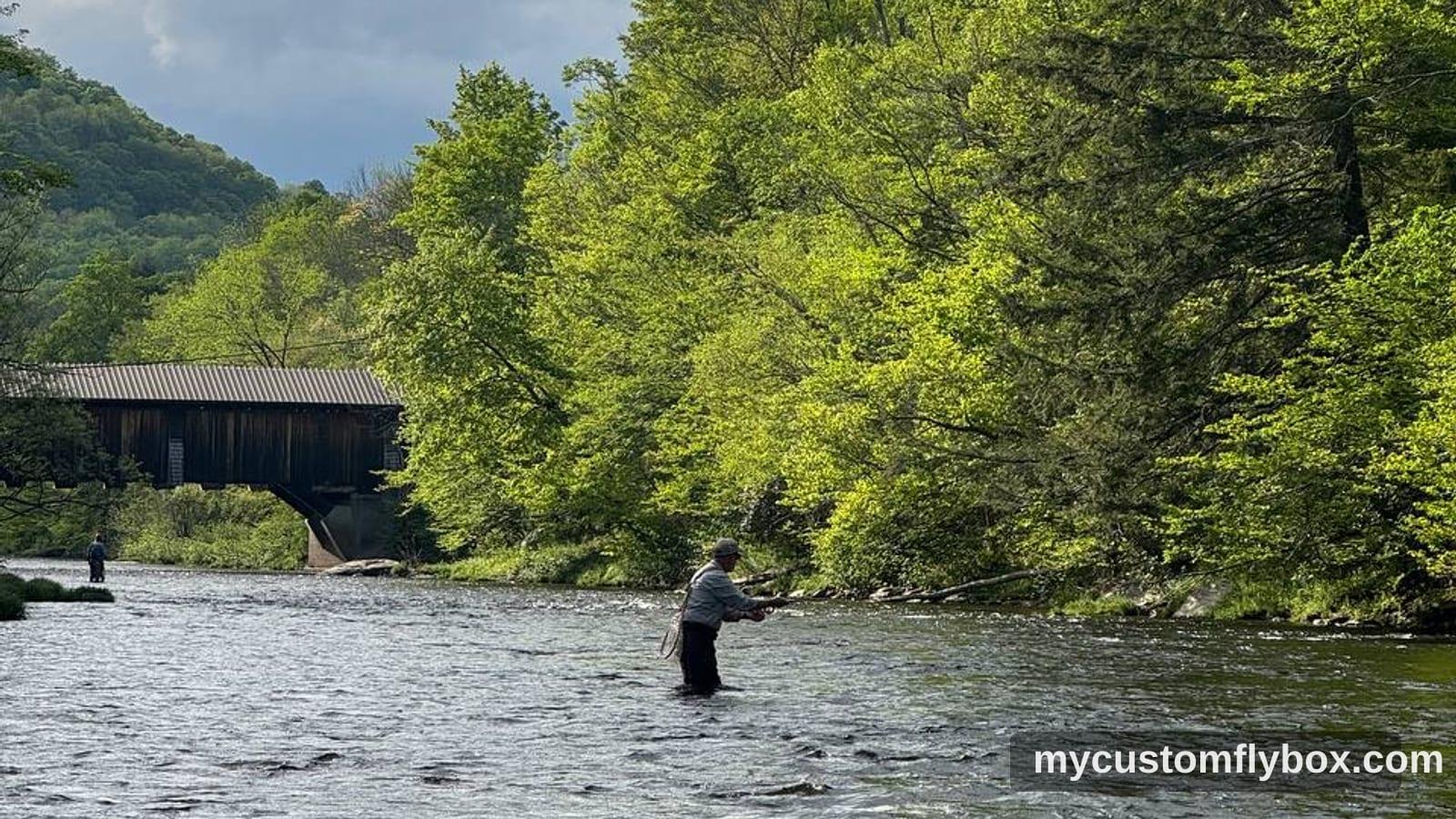
The Catskills are one of the old centers of American trout fishing: spring-fed headwaters, freestone runs, covered bridges, and long pools that have shaped how anglers talk about dry flies for more than a century. Two rivers in particular, the Beaverkill and the Willowemoc, have drawn anglers from around the world for more than a century. Both flow through the upper Catskills of New York, but they are different rivers in character, in the hatches they produce, and in the tactics that make them catchable.
This is a guide to fishing them through the season. It covers the major hatches from spring through fall, the fly selection that covers them, access considerations, and the differences between the two rivers that matter when you are picking up your rod on a Saturday morning in May.
The Two Rivers
The Willowemoc joins the Beaver Kill near Roscoe, and anglers usually talk about them together. You still fish them separately because their personalities are different from the first step into the water.
The Beaverkill is wider, deeper, and more open than most Catskill streams. It runs through a broad valley with long pools and wide glides. The river bottom shifts between gravel, sand, and large ledge rock. The Beaver Kill supports wild brown trout along with stocked trout in some reaches. Because of its size, wading can be challenging at higher flows, and drift boats are common from late spring through fall.
The Willowemoc is narrower and faster, with steeper banks and more forest cover along much of its length. It has strong wild brown trout water and a more intimate feel than the Beaver Kill. The Willowemoc is also more sensitive to water clarity: stained water can make it difficult to fish well, while the larger Beaver Kill may still offer fishable edge water and softer seams.
Both rivers change quickly through early summer. You can check current conditions at the Beaverkill and Willowemoc fly fishing reports or the West Branch Delaware report for nearby reference.
Seasonal Breakdown
Early Season: March and April
Check the current New York DEC trout regulations before you go, especially on special-regulation reaches. Early season on either river is cold water fishing: flows are typically high from snowmelt and spring rain, and water temperatures sit in the low to mid-forties.
Fish are not actively feeding on dry flies at this point. They are holding in slower water, often below riffles and along deep seams, and feeding on nymphs that drift near the bottom. Your best option is a two-nymph rig or a dead-drift nymph presentation on a single indicator.
The early season hatches are limited. You might see a few March Brown duns on a warm afternoon in late April, but the primary take is subsurface. Carry nymphs in olive, brown, and black. Size 12 stonefly nymphs and size 14 to 18 Pheasant Tails handle most of the insect activity that shows up.
Early season also means cold water and cold air. Bring neoprene waders, keep your hands in your pockets between casts, and plan to be on the water for a few focused hours rather than a full-day drift.
Late Spring: May and Early June
May is the peak month on the Catskills. Water temperatures climb into the upper forties and low fifties, fish move shallower, and hatches become frequent and sometimes heavy. The Hendrickson hatch is the headline event. These large mayflies emerge in May, often on the Beaverkill before they show up on the Willowemoc, and they produce some of the best dry fly fishing of the year.
Hendrickson duns run about size 14, and they emerge in the late afternoon, usually between 4 and 7 p.m. depending on daylight and cloud cover. Look for rising fish in the slower glides and along the seams: the fish move from the holding holes to the surface to take the duns. A foam or fiber post Adams or a Parachute Adams in size 14 or 16 handles most Hendrickson presentations.
After the Hendricksons, the Sulphur hatch begins in late May and runs through June on both rivers. Sulphurs are smaller: size 16 to 20: and they show up more often on the Willowemoc than the Beaverkill. The Sulphur hatch is less dramatic than the Hendrickson, but the fishing can be just as good because Sulphurs emerge over a longer window and feed fish through much of the day.
Late spring is also when you see consistent Blue Winged Olive activity on both rivers. BWOs are olive-gray mayflies that range from size 16 to 22 and can show up any time from April through October. On the Beaverkill and Willowemoc, BWO hatches are most common in the afternoon and late afternoon, and they are often the difference between a good day and a great day when the big hatches slow down.
This is the time to carry a full selection of dries alongside a dry-dropper rig. Tie a size 14 Hendrickson or Adams to the point, add a Pheasant Tail or BWO nymph two feet below, and you cover both surface and subsurface takes. The May fly box guide goes deeper into the specific patterns that make up this period.
Midsummer: July and August
Summer on the Catskills is different from summer in the Rockies or the West. Water temperatures on the Beaver Kill and Willowemoc can stay comfortable when flows are steady and nights are cool, but they are still freestone trout streams and heat waves matter. The Willowemoc often holds cool water well, while the Beaver Kill needs more attention during low, hot stretches.
Summer brings the caddis hatch. Tan and dark caddis emerge daily on both rivers, often in the late afternoon when temperatures peak. A small foam spider or an Elk Hair Caddis in size 14 to 18 is a good general pattern. Caddis are active from dawn until the heat of midday, and they often show up after a rain, which washes emerging pupae into the stream from the banks.
Summer also brings lower flows, which means more access to wadeable pools that are closed in spring. But lower flows mean clearer water, which means longer leaders, finer tippet, and more stealth. A 13-foot leader with 5X or 6X tippet is more practical than a 9-foot outfit in clear, low water. Trout are bigger and more spooked when the water runs off in July and August, especially on the Beaverkill, where the fish have seen more angling pressure through the year.
Be aware of water temperature thresholds in the summer. While the Catskills stay cooler than most freestone rivers, heat waves in July and August can push water temperatures above 65 F on the Beaverkill, at which point fishing pressure should be reduced or stopped entirely to protect the fish.
Fall: September and October
Fall on the Beaverkill and Willowemoc is the best fishing of the year for many anglers, and for reasons that have nothing to do with hatches. The water cools, flows are usually low and clear, and brown trout move into shallower water to feed aggressively ahead of winter. September can produce some of the most consistent dry fly and nymph fishing of any month.
The BWO hatch is still reliable, but the primary driver in fall is the trout's feeding behavior, not the insects. Brown trout are at their most active in September and early October, and they take flies that other months would pass up. A soft hackle wet fly, a small streamer, or a large mayfly nymph can produce fish even when no hatch is visible.
Caddis activity tapers off as water temperatures drop below 55 F, and you see fewer dry fly takes. But the fall fish take dries when they show up, and on warm September afternoons, the Beaverkill can produce surface takes from midmorning into the evening.
Fall is also the best time to wade sections that are difficult or unsafe at higher spring flows. The lower Beaver Kill and the larger pools near Roscoe and downstream toward the East Branch become much more approachable in October than they are in June. On the Willowemoc, look for broken pocket water, shaded banks, and the softer seams below riffles when flows are low and clear.
Major Hatches and What to Carry
The Beaverkill and Willowemoc produce a core set of hatches every year, though exact timing varies with water temperature and weather. Here is the hatch calendar that most guides and local shops use.
March Brown (late spring). Size 12 to 16. These larger mayflies are part of the late-spring Catskill window, often around the same period anglers are watching for Hendricksons, caddis, and the first Sulphurs. A Pheasant Tail nymph in size 12 to 16 is the essential imitation. A dark dun dry fly in size 12 to 14 works for the emergers.
Hendrickson (May). Size 10 to 14. The most famous Catskill hatch. Emerges in the late afternoon. Carry a foam Adams or Elk Hair Caddis in size 12 to 14, plus a Pheasant Tail or Hare's Ear nymph for subsurface takes.
Sulphur (Late May–June). Size 16 to 20. Smaller and less showy than the Hendrickson, but often produces more consistent fishing. A Parachute Adams or a CDC dry fly in size 18 to 20, plus a small Pheasant Tail nymph in the same size range.
Blue Winged Olive (April–October). Size 16 to 22. The most consistent hatch across the entire season. Olive dun dry flies in 18 and 20, and olive nymph imitations in the same sizes. A BWO hatch is the reason most anglers carry a Parachute Adams and a Pheasant Tail on every trip.
Caddis (May–October). Tan and dark varieties. Size 10 to 18. An Elk Hair Caddis in size 14 and a foam spider in size 16 cover most of the tan caddis. A dark caddis larva pattern in size 14 to 16 covers the darker varieties.
This is the fly selection that a competent angler should have on hand. If you use the My Custom FlyBox app to organize your selections, a good starting point is a dedicated "Catskill" box with the patterns listed above, plus a few spare tieings of each. The app makes it easy to track which patterns you actually used on a given day, which is useful data when you return to the same river a month later.
Access and Regulations
The Beaverkill and Willowemoc are regulated by the New York State DEC, and both rivers include reaches with special trout regulations. Before you fish, check the current DEC inland trout regulations for open seasons, tackle rules, harvest rules, and any reach-specific restrictions.
Access is a mix of public fishing rights, bridge crossings, roadside pull-offs, and private water. Use marked access points, stay below the high-water line where public access allows it, and do not assume an open-looking bank is public. If you are unsure, move on to a signed access point or ask locally before stepping in.
Fly Box Setup
A practical fly box for the Beaverkill and Willowemoc has three sections: dries, nymphs, and emergers. On days when you are serious about covering both rivers, carry a second box with streamers and tippet.
Dry flies (primary box).
- Parachute Adams: sizes 14, 16, 18
- Sulphur or Light Cahill dry: sizes 16, 18
- Elk Hair Caddis: sizes 14, 16
- Foam Spider: sizes 16, 18 (good for windy days and low visibility)
- Hendrickson imitation: size 12, 14 (May only)
- Sulphur imitation: size 18 (late May and June)
Nymphs and emergers (primary box).
- Pheasant Tail: sizes 14, 16, 18, 20
- Hare's Ear: sizes 14, 16
- Stonefly nymph: size 12 (March and April, May for stoneflies)
- Zebra Midge: sizes 18, 20 (on spring creeks and during BWO midge activity)
- Soft hackle: sizes 16, 18 (fall and low-water periods)
Secondary box (streamers and tools).
- Woolly Bugger: sizes 8, 10, black and olive
- Little Black Bugger: size 10
- 5X and 6X tippet spools
- 4X tippet for larger dries in May
This selection covers the major hatches from April through October. It is not a minimal box, but the Beaverkill and Willowemoc produce enough variety in their insect life that a minimal approach leaves you without the right pattern when a hatch is on.
Tactics That Work
The Beaverkill and Willowemoc reward a specific set of tactics that differ from the freestone rivers of the Rockies or the smaller spring creeks of Pennsylvania.
Dry fly fishing on the Beaverkill is most productive from mid- to late afternoon, when the sun is lower and fish move into the shallower glides. Cast upstream or across, mend your line to let the dry fly drift naturally, and keep your second rod ready for a follow-up take. The water is wide enough that you can approach fish from a distance, but the clarity in summer means your wading approach still matters.
Nymphing on the Willowemoc is the primary method on most days, especially in May and June when fish are feeding subsurface between dry fly takes. A two-nymph rig with a Pheasant Tail and a Prince Nymph or Hare's Ear, drifted under an indicator, covers a wide range of conditions. The Willowemoc's faster water means you need enough weight in your rig to get the flies to the bottom on the first drift, but not so much that your presentation looks heavy to the fish.
Dry-dropper is the single most versatile technique on both rivers. A buoyant dry fly on the surface with a nymph two feet below lets you fish two depths at once. Fish a dry fly on the surface with a nymph trailing beneath it on the Beaverkill from late May through September, and you are set up for whichever take comes next.
A Note on Safety and Stewardship
The Beaverkill and Willowemoc are not dangerous rivers, but they demand basic respect. Spring flows can be deceptively high, and the Beaverkill is wide enough that a current sweep can take a wader into the bank or flip them if they are not careful. Wading boots with felt or grippy rubber soles are essential, especially on the smooth rock that makes up much of the Beaverkill bottom.
In July and August, water temperatures can rise above the comfortable range for trout. If the water is above 65 F, limit your time on the river and practice catch-and-release strictly. A fish that is handled in warm water has a much lower chance of surviving. The water temperature article goes into detail on the thresholds and the biology behind them.
Both rivers support significant wild trout populations. Practice wading etiquette, keep to marked access points, and be prepared to leave private property when you are asked to. The Catskills have been fished hard for a long time, and the angling community here has a strong tradition of stewardship. Protecting the fish and the habitat is part of what keeps the Beaverkill and Willowemoc as good as they are.