The May Fly Box for Catskills Trout
By My Custom FlyBox Guide
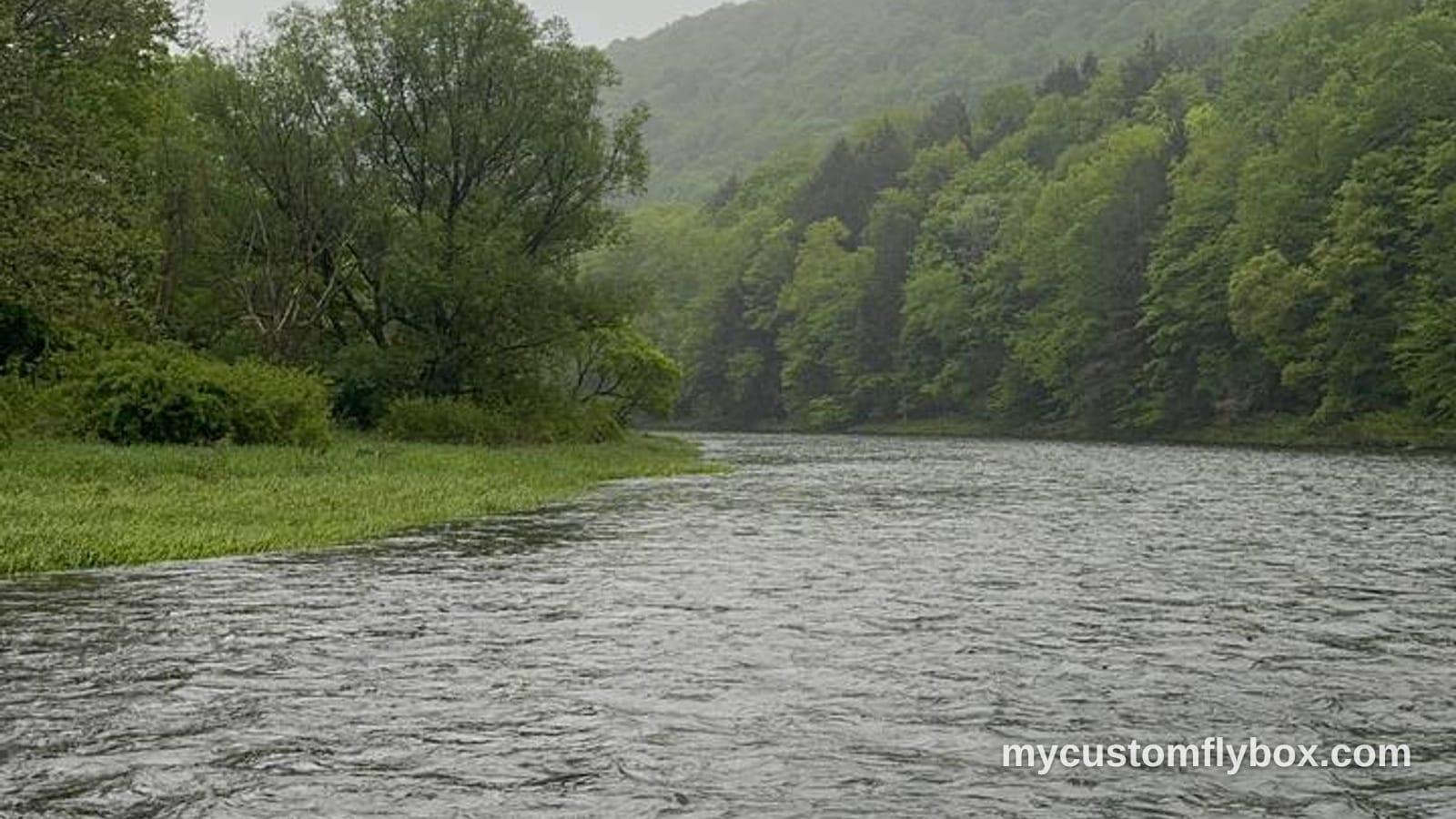
May on the Catskills does not arrive all at once. Early May is still cold, sometimes cold enough to keep the water near 45 F when the sun is up. Late May can carry a late-spring heat that pushes shallow freestone sections past the point where trout want to hold. Between those extremes, May is one of the richest hatches on the Catskill freestones and spring creeks. It is also the month when the most common mistake is bringing the wrong box.
A well-packed May fly box on the Catskills does not need to be large. What it does need is to follow the hatches in order, cover the dry-dropper rigs that will work between them, and carry enough variation to handle the swings that happen when a low-pressure system moves through or the gauge jumps overnight after rain. This guide breaks down what works, when it matters, and how to organize the box so you are not fumbling at the water.
Why May Is Different on the Catskills
May is the bridge between spring and summer on the Catskill streams. The water is rising, the insect activity ramps up across multiple species, and the fish are feeding hard after winter. That combination makes May productive, but it also compresses the window. Fish that will sit deep in a seam at 8 a.m. may work the main riffle by noon when the hatch hits and the light drops. If your box is not organized to match that shift, you lose time you cannot get back.
The Catskills also have two major systems that fish differently in May: the Beaverkill and Willowemoc, which run through Roscoe and are managed as free fishing waters by the DEC, and the smaller tributaries like the Delaware River tributaries, the Neversink, and the various spring-influenced waters in Ulster and Sullivan counties. Each has its own microclimate and hatch timing. The general pattern below holds across the region, but a specific hatch may appear a few days early on a warm spring or linger late if a cold front holds things back.
Before you pack, check the flow. The Beaverkill and Willowemoc have USGS gauges, and the West Branch Delaware has its own. A rapid rise of fifty cfs or more after rain will change everything about how you fish that day. If you need help reading those gauges, the guide on how to read a USGS gauge covers what the numbers actually mean before you step in the water.
Early May: BWOs, Duns, and Soft Hackles
Early May on the Catskills is dominated by Blue Wing Olives and early yellow duns. The BWOs typically begin in the afternoon, sometimes as early as 10 a.m. on a warm, overcast day, and hold into the evening. Sizes 16 through 20 are the most common, with 18 and 20 being the bread and butter. You should expect BWOs to show up on a variety of surfaces: the main run, slower pocket water, and even the edges of riffles. They are not strictly a dry fly hatch in early May, which means you should have both dry and wet options ready.
For dry BWOs, carry the following patterns in the suggested sizes:
- Elk Hair BWO: size 18, 20. A reliable emerger imitation that works when the mayflies are coming off.
- Parachute Adams: size 16, 18, 20. Not a true BWO, but a great secondary choice when the fish are feeding on generic mayfly activity and you cannot be sure which species is hatching.
- BWO Dun: size 16, 18. A more realistic imitation with a tied-wing hackle. Best when the BWOs are walking on the surface with their wings upright.
- Sparkle Dun: size 18, 20. A slightly larger, more visible pattern that can work when the real mayflies are scarce or when the fish are holding lower in the water.
For wet and nymph options, which will be the primary method in early morning and between dry rises:
- Hare's Ear nymph: size 16, 18, 20. A general attractor that covers a wide range of brown and olive nymph activity.
- Pheasant Tail nymph: size 16, 18, 20. The go-to nymph for mayfly nymphs and early emerger imitations.
- Soft hackle wet fly: size 16, 18. A midge or small mayfly imitation worked slowly in the seams. Soft hackles are one of the most underrated patterns for late-spring Catskills trout.
- BWO nymph imitation: if you carry a specific BWO pattern, tie it in size 18 and 20. Many guides and local shops carry a version of this.
The dry-dropper rig is particularly effective on the Beaverkill and Willowemoc in early May. Tie a BWO dry fly or a size 18 Parachute Adams to the dropper and a BWO nymph or Pheasant Tail to a foot or two below. Cast into the seam, let it swing naturally, and keep your rod hand close to the line for a quick mend when a fish takes the wet fly.
Mid-May: Hendricksons, Stoneflies, and Caddis
Mid-May brings the first serious mayfly hatch of the season on many Catskill streams: the Hendrickson. The Hendrickson is one of the most famous trout hatches in the Northeast. The duns are larger than BWOs, typically sizes 10 through 14, and the emergence can happen in a concentrated window that lasts anywhere from thirty minutes to two hours. During a good Hendrickson, trout can be taken on the surface all afternoon, and fish that spent the morning deep in the water will work the riffles and runs.
For Hendrickson activity, carry these patterns:
- Hendrickson dry fly: sizes 10, 12, 14. The primary imitation. A well-tied Hendrickson has a pale yellow or buff body, a grayish hackle, and a proportioned body that matches the real dun.
- Elk Hair Caddis: size 12, 14. A reliable backup during Hendrickson periods when the dry fly is not working. The Elk Hair Caddis floats high and imitates both caddis and mayflies.
- Caddis pupa imitation: size 12, 14. If you are fishing a dry-dropper rig during a Hendrickson hatch, a caddis pupa on the dropper can trigger strikes when the fish are ignoring the dry fly.
- Stonefly nymph: size 10, 12. Late-May stonefly hatches often coincide with the first Hendricksons. A stonefly nymph on the dropper of a dry-dropper rig or as a weighted nymph presentation can pull fish from the tailout.
Stoneflies in May are not as abundant as they are on the Madison or other western waters, but they are present on Catskill streams. Golden Stoneflies begin to show up in late May, and their larger size (size 8 to 10) means you should carry a Golden Stonefly dry or a Stimulator if you plan on fishing the Beaverkill into June.
Caddis activity ramps up through mid-May. Green caddis and brown caddis are both present, and evening caddis hatches on the Beaverkill can be steady. Carry a few Elk Hair Caddis patterns in sizes 12 through 16. A black or olive variant is useful for evening fishing when the light is low.
Late May: The Big Events and the Heat
Late May on the Catskills is a month of transitions. The Hendricksons are at their peak or winding down. The Stonefly hatch begins. Caddis activity is heavy, especially in the evenings. And the water temperature on many freestones starts creeping into the range where you need to pay attention to fish care.
If you are fishing the Catskills in late May, expect three things:
- Mixed hatches. Fish may be taking Hendricksons at noon, caddis in the evening, and BWOs early the next morning. Your box should not force you to choose between dry and wet.
- Heat stress. By late May, shallow freestone sections can reach temperatures that are uncomfortable for trout, particularly after a warm afternoon. The guide on water temperature and trout covers the practical rules for knowing when to stop fishing for trout and when to move somewhere else.
- Higher, faster water. Late-May rain events can push the Beaverkill and Willowemoc above wadeable levels. If the gauge shows a rapid rise, focus on accessible bank fishing from soft-edged runs rather than crossing deep water.
For late May, add these to the box:
- Stimulator: size 10, 12. A general attractor that imitates stoneflies and works well as a dry-dropper dry fly when nothing is hatching.
- Golden Stonefly dry: size 8, 10. The stonefly hatch may not be massive in May, but when it shows up, it is noticeable.
- Zebra Midge: sizes 18, 20. Midge activity is always present, even when larger hatches are happening. A Zebra Midge on a dry-dropper rig below a surface dry fly can pull fish that ignore the larger patterns.
- Ant: size 12, 14. Late May brings ant activity, especially on the overwater sections of the Beaverkill near Roscoe and on the Willowemoc's shade-heavy runs. An ant can be an effective surface pattern when the light is low and no mayflies are present.
Organizing the Box
How you pack the box matters as much as what you pack. A disorganized fly box wastes time at the water, and May on the Catskills rewards anglers who can switch presentations quickly.
Organize your box in three groups:
Group 1: Dry flies. Place these on the top or in the most accessible compartment. The dry flies you reach for first should be your BWO patterns (sizes 16, 18, 20), your Parachute Adams (sizes 16, 18, 20), your Hendrickson (sizes 10, 12, 14), and your Elk Hair Caddis (sizes 12, 14). Keep a few Stimulators and a PMDG toward the edge of the dry fly compartment.
Group 2: Nymphs and wet flies. These go in a lower compartment or a separate box. Your core nymphs for May are the Pheasant Tail (sizes 16, 18, 20), the Hare's Ear (sizes 16, 18, 20), and at least one BWO nymph imitation (sizes 18, 20). Soft hackles in size 16 and 18 are worth carrying if you do not already have them.
Group 3: Tippet and leaders. Carry a spool of 4X tippet for general nymphing and dry-dropper rigs. A spool of 5X for smaller BWOs and clear, pressured water. A spool of 2X or 3X for Hendrickson and stonefly presentations where you need to match the size of the dry fly with a heavier leader.
A practical packing strategy is to pre-tie six to ten patterns before the trip, spaced across the sizes you are most likely to need. Do not tie every fly in your box. The ones you do not use can stay in the box, but the ones you reach for should already be on your line or within arm's reach.
When to Fish Dry, When to Fish Wet
In May, the decision between dry and wet is not always obvious. Here are some practical signals:
- Overcast, cool mornings: fish are more likely to take nymphs and wet flies. The surface activity has not started, or it is sparse. Start with a BWO nymph or Pheasant Tail on a dry-dropper or a two-nymph rig.
- Partly sunny, warming water: BWOs may start showing by midday. Transition to a dry-dropper rig with a small dry fly on the surface and a nymph below.
- Afternoon, clear sky, fish rising: switch to a dry fly. If the hatch is BWOs, use a size 18 or 20 Elk Hair BWO. If the hatch is Hendrickson, use a proper Hendrickson in the correct size.
- Evening, overcast or light rain: caddis and ants are most likely. Use an Elk Hair Caddis in olive or black, or an ant if you are on an overwater section.
- High, fast, cloudy water after rain: wet flies and nymphs. Dry flies rarely work well in stained, rising water. A weighted Pheasant Tail or Hare's Ear on a high-stick drift is more reliable.
Fly Selection Tips
The biggest mistake anglers make with their May fly box is packing too many large flies. The BWOs and early duns are small. Most of your box should consist of sizes 16 through 20. A box loaded with size 10 and 12 flies will look impressive, but it will not help you on a typical mid-May morning on the Beaverkill.
Second, do not underestimate the value of imitation flies over attractors. On the Catskills, fish have seen the standard attractor patterns thousands of times. When a BWO hatch is on, a well-imitated BWO Dun or a Pheasant Tail nymph will outperform a Hare's Ear or a Prince Nymph. Save the attractors for the times when the fish are unfocused: usually early in the morning or after a weather front.
Third, carry extra small flies. You will break off size 18 and 20 flies more often than you expect. A spare Pheasant Tail, BWO Dun, and Elk Hair BWO in each of those sizes is worth the space.
Checking Conditions Before You Go
Your fly box is only one part of the equation. Before you head out in May, check the conditions:
- Flow: Look up the gauge for the specific reach you are fishing. A rising Beaverkill is a different fishery from a falling one. Check the USGS gauge for the Beaverkill at Roscoe (USGS 01420500) and the Willowemoc near Shandaken (USGS 01417000).
- Temperature: Carry a thermometer. Check the water every hour during long drifts. If the water is above 68 F, consider shifting to a tailwater or a spring-influenced stream that stays cooler.
- Weather: May weather on the Catskills is unpredictable. A clear morning can turn into a thunderstorm by early afternoon. Pack a rain shell and plan for a morning-first strategy when warm weather is in the forecast.
Summary: Your May Fly Box Checklist
Here is a concise checklist you can carry to the tying station:
- Elk Hair BWO: size 18, 20 (one each)
- Parachute Adams: size 16, 18, 20 (one each)
- BWO Dun: size 18, 20 (one each)
- Sparkle Dun: size 20 (one)
- Hendrickson: size 12 (one)
- Elk Hair Caddis: size 12, 14, olive and black (one each)
- Stimulator: size 12 (one)
- Pheasant Tail nymph: size 16, 18, 20 (one each)
- Hare's Ear nymph: size 16, 18 (one each)
- BWO nymph imitation: size 18, 20 (one each)
- Soft hackle wet fly: size 16, 18 (one each)
- Zebra Midge: size 18, 20 (one each)
- Ant: size 12, 14 (one each)
- Tippet: 2X, 3X, 4X, 5X
This is not a large box. It covers the May hatches on the Catskills from early morning BWOs to late-evening caddis, from dry flies to nymphs, and from cool spring water to warm afternoons. If you start from this list and adjust based on what you see on the water, you will be better prepared than most anglers in the water.
For specific conditions on the Beaverkill and Willowemoc, check our Catskills fishing reports for current flow, temperature, and hatch activity. For a similar spring-fishing reference on the Upper Delaware, see our West Branch Delaware reports.
References
- U.S. Geological Survey (USGS) water data. BeaverKill Cr near Roscoe NY (station 01420500) and Willowemoc Cr near Shandaken NY (station 01417000). Accessed 2026-06-01 via waterdata.usgs.gov.
- New York State DEC freshwater fishing regulations and trout stream classifications. Accessed 2026-06-01 via dec.ny.gov.
- General May hatch timing for the Catskills region based on local angler consensus and published regional fly fishing references. Specific hatch timing varies by year, elevation, and local microclimate.